
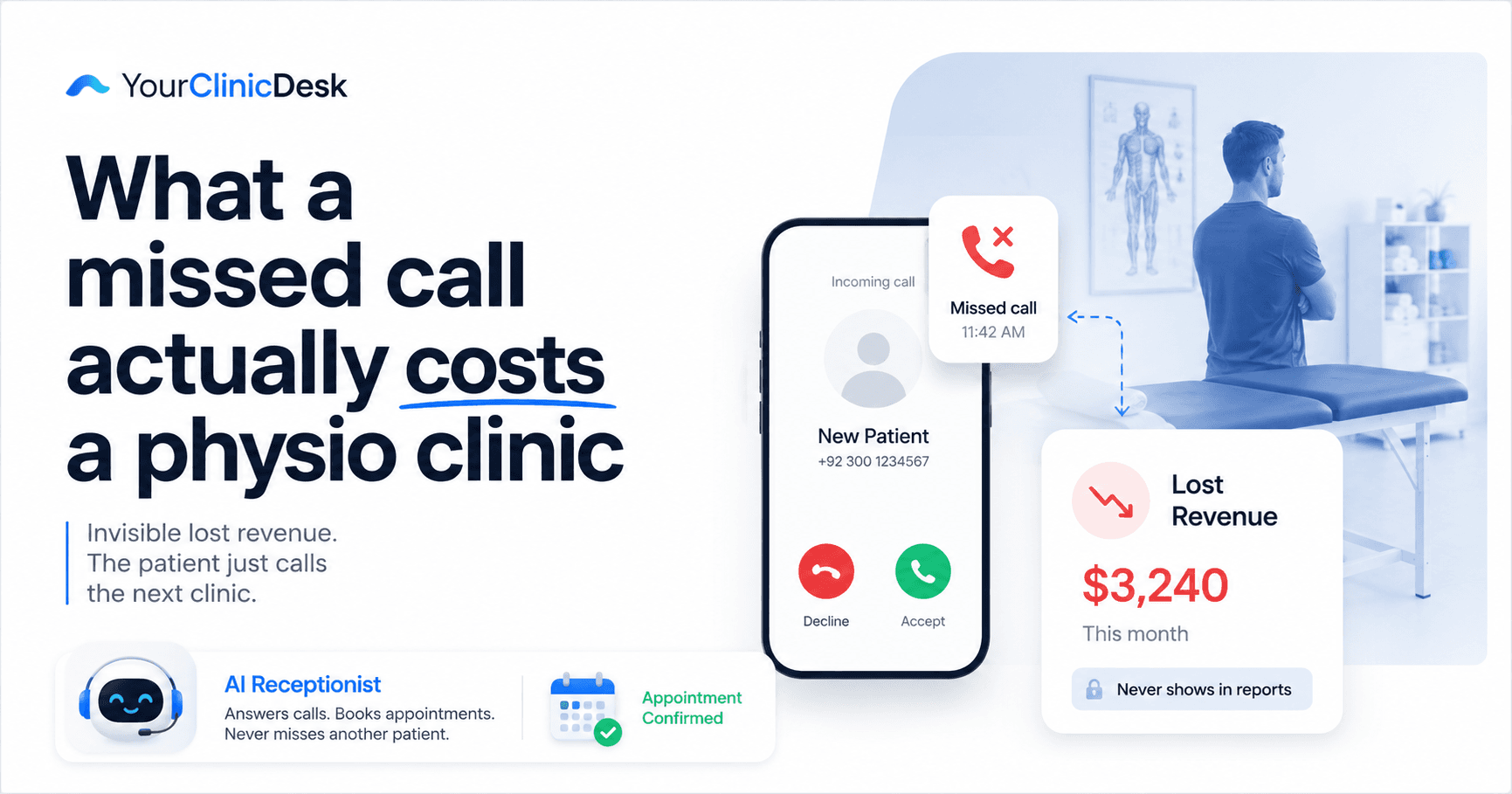
Most clinics track a lot of numbers. Patients seen per day, average session value, no-show rate. Almost none track the one that is quietly costing the most: how many calls go unanswered, and what happens to those patients afterwards.
The honest answer, most of the time, is nothing good. They call the next clinic on the list.
The math clinics don’t usually do
Take a fairly typical physio clinic: a handful of practitioners, a reception desk staffed during business hours, closed evenings and weekends.
Now think about when people actually decide to book. A sore back after a weekend of gardening. A tweaked knee during a Tuesday evening run. A referral letter someone finally gets around to acting on after dinner. None of that lines up neatly with 9-to-5.
If even a handful of calls a week land outside business hours, or during a busy stretch when reception is mid-conversation with someone else, that is a handful of patients a week who do not get an answer. Some will call back. Many won’t. They will simply ring the next name on their shortlist.
What 3 missed calls a week add up to over a quarter
- Missed calls / week
- 3
- Would have booked
- 40%
- Value per patient
- $320
Illustrative only. Swap in your clinic’s own consult fee and follow-up rate and the shape stays the same. The line only ever goes up, because nothing in the diary records the patients who never got through.
A few missed calls a week adds up to a real, recurring number by the end of a quarter. That is not a rounding error. It is a genuine dent in revenue that never shows up in any report, because a missed call doesn’t leave a trace.
There is no line item for “patient who called and gave up.”
Why this is worse for physio specifically
A few things make missed calls sting more for physio clinics than for some other businesses.
The decision window is short
Someone in pain right now is choosing between clinics right now, not researching for a week. If your competitor answers and you don’t, you have usually lost that patient for good, not just for this one call.
Referrals are time-sensitive too
A GP hands someone a referral, and there is a real chance that patient books wherever is easiest, not necessarily the clinic the GP intended, if the first clinic they try doesn’t pick up.
Reception is often one person doing several jobs
Checking in patients at the desk, taking payments, answering the phone, all at the same time. That is not a staffing failure. It is what running a small clinic looks like. But it does mean the phone loses out during busy stretches, exactly when demand is highest.
What to actually do about it
You do not need to hire another receptionist to fix this. A few practical options, roughly in order of effort:
- Track it for two weeks. Ask reception to note, even roughly, how many calls go to voicemail or ring out in a normal week. Most owners are surprised once they actually look.
- Add a way to book without a phone call at all. A booking widget or live chat that can hold a spot recovers a chunk of the after-hours and busy-period losses on its own.
- Have something answer when reception genuinely can’t. It needs to handle the basics and get the booking into the calendar, even if a person follows up afterwards.
That third option is what we built YourClinicDesk for: an AI receptionist that answers patient questions and books the appointment on the spot, using the calendar your clinic already runs, with no new practice software to learn. It is not a replacement for your front desk. It is what catches the calls and messages your front desk physically cannot get to.